Accounts
 Currency
 Items
Items


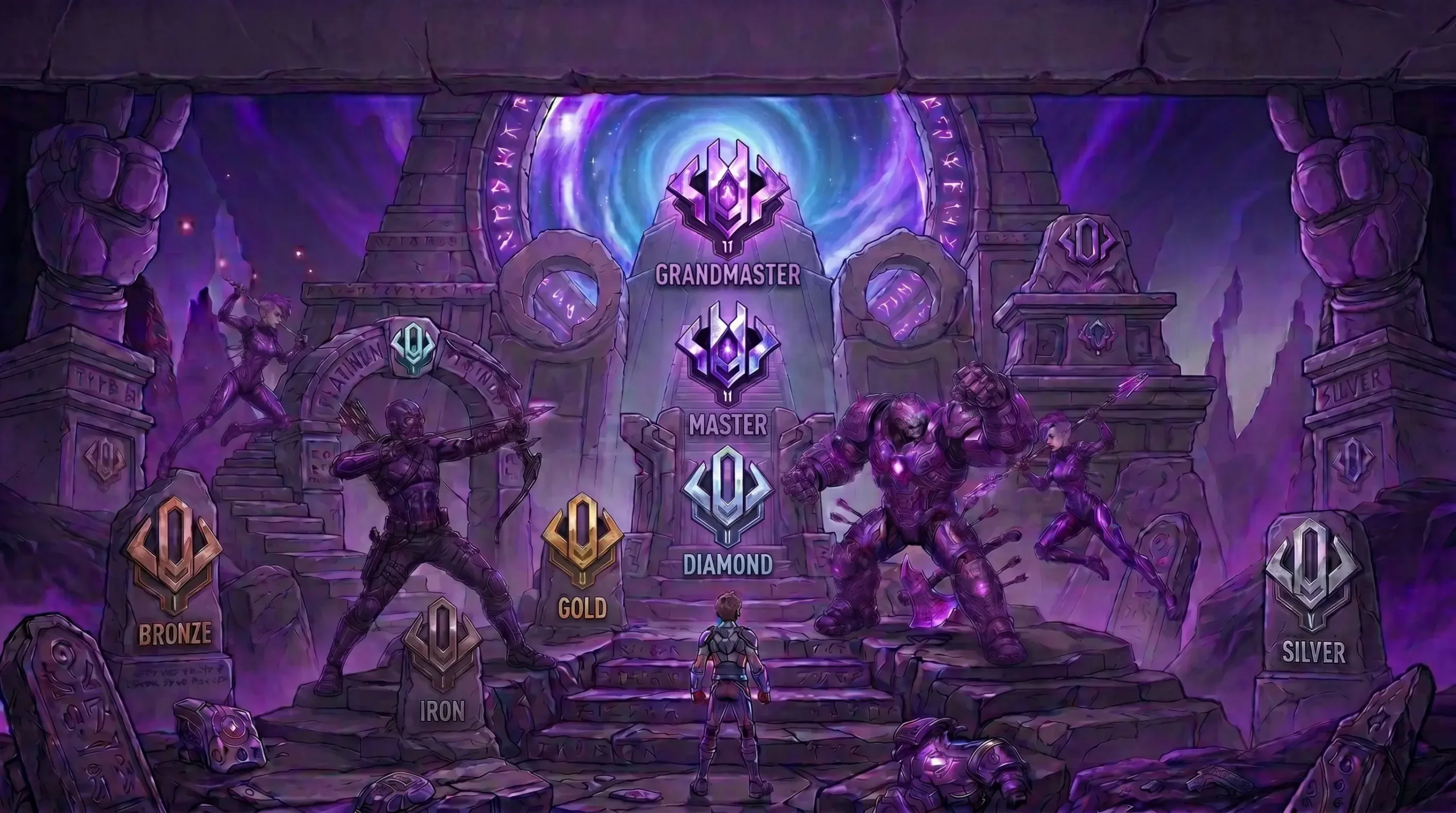
Marvel Rivals Ranks Explained — All Tiers & Rewards
Marvel Rivals ranks span 9 distinct tiers and 23 divisions, ranging from Bronze III at the bottom to One Above All at the peak. The competitive mode unlocks at account Level 15 after accumulating experience in casual matches. This guide covers every tier in the Marvel Rivals ranking system, the Rank Point progression mechanic, current distribution data for Season 7, seasonal rewards including exclusive skins, and the party restrictions that determine what ranks can play together in Marvel Rivals.
What are the ranks in Marvel Rivals?
The ranks consist of 9 tiers, each representing a different competitive skill bracket. All ranks in Marvel Rivals, listed from lowest to highest, are:
1. Bronze (III, II, I)
2. Silver (III, II, I)
3. Gold (III, II, I)
4. Platinum (III, II, I)
5. Diamond (III, II, I)
6. Grandmaster (III, II, I)
7. Celestial (III, II, I)
8. Eternity (no divisions)
9. One Above All (no divisions)
Each rank tier (Bronze to Celestial) has 3 sections – III, II, and I. So, as you progress through the rank tiers, you will actually decrease in the number of sections (III, II, I) within a tier. Also worth noting is that each division decreases by 100 RP, and there are 3 divisions in total; every 100 RP will advance a player one division. Eternity and One Above All operate differently: both lack divisions, and the Marvel Rivals rank list places them as the final two tiers reserved for elite competitors. The Marvel Rivals ranks in order, a total of 23 distinct placements across all 9 tiers.
What is the highest rank in Marvel Rivals?
Highest Rank in Marvel Rivals? One above all. No caps other than 500 players per platform for One Above All. The rank right before One Above All is Eternity. You will need to reach Celestial I to be in the Eternity rank, where you can earn Rank Points to rise through the rank levels. The 500 players with the most Eternity points will ascend to the One Above All rank each season. One Above All resets with the start of each new season.
How does the Marvel Rivals Ranks system work?
The Marvel Rivals ranks system uses Rank Points (RP) as the primary progression currency. Winning a competitive match earns RP, and losing a match deducts RP. Every 100 RP accumulated advances a player by one division (for example, from Gold III to Gold II).
As you play more matches and win, your progress to the next promotion can increase exponentially. Some matches are going to give you a higher RP multiplier for that specific match, which, in addition to the RP win streak multiplier, will result in an increased overall progress for the match. Additionally, one player will receive a bonus for being the highest performer in that match, which will be significantly higher than their base MVP for your win(s). Some matches may also skip a sub-tier of progress for the match where you earn increased RP to help boost you towards the next promotion. The Marvel Rivals ranked system penalizes losses proportionally: dropping below a division’s RP threshold triggers demotion to the division below. Understanding how Marvel Rivals ranks work requires tracking both win/loss RP and the streak/MVP bonuses that accelerate or cushion the climb.
What is the Chrono Shield in Marvel Rivals?
The Chrono Shield is a demotion-protection mechanic available to players at Gold rank and below. This works by forcing this trigger to activate at specific times. It will activate automatically when such a loss would result in a demotion to Division C to soak the loss with zero RP change. It will not activate in losses, which would result in a lower RP. It won’t prevent you from losing RP for regular losses; it’s just designed to activate at the demotion line.
The Chrono Shield will recharge after a certain number of losses, similar to previous events, and the number of losses needed to recharge the shield will increase as you move up the divisions in the Gold-and-below ranking. In addition to Chrono Shield Cards, you can also use Galacta’s Gift Passes. These were provided in previous events and will provide 4 additional Chrono Shield Cards at the 6-match mark and 4 additional at the 12-match mark. Players in Platinum and above have no access to Chrono Shield protection or Chrono Shield Cards.
How does the season reset affect your rank?
Every new rank reset drops all players by 7 tiers, which equals approximately 2.3 full ranks or 700 Competitive Points. This reduction is uniform — a Grandmaster I player and a Diamond III player both lose exactly 7 tiers from their end-of-season position.
Season 7 changed how teams began each season, basing their start on their placement match performance. The statistics from the ten matches played at the beginning of each season (damage, healing, kills, and objective time) can change where teams start the season by up to ±100 CP (1 rank). As a change from previous seasons, statistics from the team’s losses are still counted towards rank placement. The Marvel Rivals rank reset mechanic ensures competitive integrity across seasons, while the placement system rewards consistent individual play.
What is the current Marvel Rivals ranks distribution?
The Marvel Rivals ranks distribution for Season 7 (April 2026) places the average player at Platinum III or Platinum II, according to data from RivalsTracker and Esports Tales. The following breakdown covers approximate player percentages per tier bracket based on PC data:
- Bronze: approximately 8–12% of the player base, primarily new or returning players.
- Silver: approximately 10–15%, players developing fundamental competitive skills.
- Gold: approximately 18–22%, the most populated individual tier in Season 7.
- Platinum: approximately 20–25%, the tier where the average player lands (Platinum III/II).
- Diamond and above: approximately 10–15% combined, representing the upper competitive bracket.
- Grandmaster: approximately 15% across its 3 divisions, based on February 2026 data from Esports Tales.
- Celestial: top 2.44% of tracked players.
- One Above All: fewer than 0.5% of the player base (top 500 per platform).
Published Marvel Rivals rank distribution data covers PC players only — console distribution may differ. The Marvel Rivals ranked percentiles shift with each season as resets compress the population toward mid-tier brackets during early weeks. Players looking to start in a higher tier without grinding through placement matches can browse Marvel Rivals accounts on GG Chest for pre-ranked profiles with verified delivery.
What ranks can play together in Marvel Rivals?
The rules for what ranks can play together in Marvel Rivals depend on the tier bracket. Three distinct restriction sets apply:
- Bronze through Gold: No rank-gap restriction. Players can queue in any party size except a full 5-stack. A Bronze III player can group with a Gold I player without limitation.
- Gold I through Celestial: Players must be within 3 divisions of each other to queue together. Party sizes of 2, 3, or 4 are permitted — 5-stacks remain restricted. A Platinum II player cannot group with a Diamond II player because the gap exceeds 3 divisions.
- Eternity and One Above All: Solo queue or duo queue only. Eternity and OAA players can team with Celestial II players within 200 Rank Points, but no larger party sizes are available.
Crossplay is disabled in competitive ranks — PC and console maintain separate queues. The Marvel Rivals ranked party limit applies to all members of the group: a single player outside the allowed range prevents the entire squad from queuing. These rank restrictions ensure competitive integrity by preventing large skill-gap disparities in ranked matches.
What are the Marvel Rivals Ranks rewards?
Each Marvel Rivals seasonal rank has its own set of rewards, including character skins, nameplate frames, and Crests of Honor, the final Crest you earn in a season based on the highest rank you peaked at. These rewards are released every season, around the same time every year, with Season 7 and Season 7.5 rewards detailed below for your peak rank position.
1. Gold and above: exclusive character skin (Season 7: White Fox Secret Agent; Season 7.5: Black Cat Beguiling Blue).
2. Platinum III and above: Gold-tier reward plus the City Stories Nameplate Frame.
3. Diamond III and above: all lower rewards plus the Tablet Tales Nameplate Frame.
4. Grandmaster III and above: Grandmaster Crest of Honor.
5. Celestial III and above: Celestial Crest of Honor.
6. Eternity and One Above All: Eternity and OAA Crest of Honor.
7. Top 500: Top 500 Crest of Honor.
Rewards will now be based on your highest rank for the season. So even if you demote to Platinum, the season can end up still rewarding you as if you were Diamond. Rewards are no longer per event and will be tied to the season. Players chasing exclusive Marvel Rivals-ranked skins from higher tiers can get a head start by picking up Marvel Rivals accounts through the marketplace.
How to rank up fast in Marvel Rivals
Climbing the Marvel Rivals ranks requires a combination of mechanical skill, game knowledge, and strategic decision-making. The following 7 strategies accelerate RP gains and minimize losses:
- Prioritize team play and communication. Just to give some frame of reference for where enemies are, ping at them. To help avoid taking as much damage, ping at enemies flanking you. Ping at enemies, saving for ults as well. Graviton Surge + ultimate (Star-Lord, for example) is WAY more RP-earning than going for Graviton Surge solo.
- Learn hero counter-picking. Mobile heroes like Spider-Man and Black Panther can go up against area denial heroes like Doctor Strange or even crowd-controlling tanks like Magneto. However, knowing some of the favorable matchups before choosing a hero can help any player, regardless of division.
- Study map layouts. Some areas of note on the map are corners, embankments, areas of high ground, and health pack spawns. These areas can be used to flank, set up, and wait for enemies to come to you. Knowing the map is key to reducing your deaths per match and increasing your individual performance and, therefore, RP gain.
- Exploit hero synergies and team-up abilities. The Marvel Rivals game allows certain pairs of heroes to form team-up abilities. Rocket Raccoon and Groot or Iron Man and Hulk for a huge synergy advantage in ranked play.
- Maintain win streaks. Four or more consecutive victories activate a bonus RP multiplier. Protecting a win streak by switching to comfort picks during uncertain matchups preserves the streak bonus and accelerates the climb through the ranked tiers.
- Target MVP performance. We’re measuring performance by the amount of damage dealt, healing done, kills, and successful completion of objectives and objective time. Players who are doing well on the leaderboard will receive more RP per win and less RP per loss.
- Use hero bans strategically (Gold III and above). Banning dominant meta heroes forces opponents off their comfort picks. Studying current ban rate data helps identify which heroes to remove for maximum competitive advantage.
Understanding how to rank up in Marvel Rivals also means recognizing when to stop. Playing on tilt after consecutive losses accelerates demotion. Taking breaks between losing streaks preserves RP and prevents further skill degradation from frustration.
How does the Hero ban system work in ranked?
Starting from Gold III, teams will be able to ban 3 heroes before the match. Just like with the previous limit of 2 hero bans per team in Season 7, there will be a minimum and a maximum of banned heroes in each match (3 or 6). Bans overlap when both teams target the same hero, reducing the total unique bans below 6.
Instead of simple majority voting, the selection of heroes to be banned will be determined by probability, weighted by the number of times each hero is selected by the players. Each player will select a single hero, and the game will then select banned heroes from the players’ selected heroes. The ban window is 15 seconds long. Effective ban strategy targets heroes with high win rates in the current meta — removing a dominant Duelist or Strategist forces opponents to adapt on the fly during the Marvel Rivals comp ranks climb.
Frequently asked questions about Marvel Rivals ranks
How many ranks are there in Marvel Rivals?
There are 9 rank tiers and 23 total divisions in Marvel Rivals ranked. The 9 tiers are Bronze, Silver, Gold, Platinum, Diamond, Grandmaster, Celestial, Eternity, and One Above All. Each tier has 3 divisions, including Bronze, Championship, and Celestial. The most elite tiers, however, Eternity and One Above All, have no divisions and are single-tiered, reserved for the best of the best players.
What level do you need to play ranked in Marvel Rivals?
Players need to reach Level 15 through casual game modes to unlock Marvel Rivals competitive ranks. No additional requirements exist beyond account level — there is no hero ownership minimum or placement prerequisite.
Does Marvel Rivals Ranked have crossplay?
No. Marvel Rivals ranked does not support crossplay between PC and console. For ranked matches, PC players will only play with other PC players, and Console players will only play with other Console players. However, in our Casual and Unranked game modes, you will be able to play with PC and Console players across all platforms.
Can you lose your rank in Marvel Rivals?
Yes. Losing matches deducts Rank Points, and dropping below a division’s RP threshold triggers demotion. For Gold and below players, the Chrono Shield will prevent 1 demotion from occurring. Players ranked Platinum and above will not experience any protection, and demotion will occur on the first loss at that rank.