Accounts
 Currency
 Items
Items


Best Valorant agents - Valorant agent tier list: Who dominates the meta in 2026?
Valorant’s meta has shifted once more — not due to abilities becoming more powerful, but rather because several of them were weakened. Utility is still significant, but it no longer overshadows as it did a few months ago; hence, execution, positioning, and raw duel power have regained prominence. Now every player is posing the same question (typically right after they lose a close 11–13): Who is the best agent for real?
In this guide, we break down the current tier list, why the S-tier picks stay on top, how map synergy warps the meta, the Valorant agents ranked by role as of January 2026, and how to choose agents if you’ve got limited time but still want to look like a menace in front of your friends.
Who are the best Valorant agents right now?
Season 2026 advanced the meta via steady, disciplined balancing instead of one dramatic change. Utility has a diminished raw impact compared to a few months ago, making success rely more on mechanics and coordination. Controllers and information are essential as they enable reliable round strategies, not due to their inherent ability to win confrontations.
So if you’re asking the same thing everyone asks after a big shake-up — who’s actually worth picking right now? — This list gives you the fastest answer.
The Valorant tier list is built around one simple idea: Which agents create reliable value even when your team doesn’t communicate. To put it differently: If you were GG Chest, focus on agents capable of creating opportunities, controlling space, and securing rounds independently of teammates’ cooperation.
So, Valorant’s best agent… who is it?
If you want a single name, here’s the truth: There isn’t one “best agent” for every player and every map. But some agents stay elite because their kits solve problems on any team.
Right now, Jett remains the safest bet for raw carry potential, while Omen is the smartest “I want to win more games with fewer headaches” pick. Your game results depend on your current location, your map choice, and your decision between killing enemies and defending your rounds.
Valorant agent tier list explained (January 2026)
Tier list ranks agents based on their performance in Season 2026, taking into account recent balance changes, map rotations, and how agents perform in real ranked environments — not just coordinated pro play.
The rankings focus on round impact, consistency, and how easily an agent provides value, especially for players with limited time who still want reliable results. You can get to know the agent tier list below:
S: Jett, Omen
A: Astra, Neon, Raze, KAY/O, Fade, Yoru, Viper, Killjoy, Sova
B: Breach, Chamber, Veto, Deadlock, Skye, Waylay, Sage, Iso, Clove, Brimstone
C: Cypher, Tejo, Phoenix, Harbor, Reyna
D: Vyse, Gekko

Below is a breakdown of why each tier looks the way it does, including role distribution and playstyle strengths.
S-tier Valorant agents
Roles represented: Duelist (Jett), Controller (Omen).
- Jett remains the most dominant duelist in Valorant. Her mobility allows her to take aggressive angles, escape danger, and apply constant pressure without relying on teammates. She is likewise the top Operator user in the game, ensuring her relevance through various metas. Even if she doesn’t achieve early kills, her mere presence compels defenders to adopt a more cautious approach. That’s the true strength: She alters what the opponent can undertake.
- Omen earns S-tier status because of his unmatched flexibility. His mid-round smoke adjustments, combined with his blind ability, create automatic winning situations, which his teleport function enables him to move around the map or escape from errors. Omen allows players to rely on his ability to fix ranked match rounds, making him the top option for strategic failure scenarios. Omen’s solution for communication breakdowns within the team offers an efficient approach to managing circumstances, as players must protect their area while preventing information leakage and addressing personal disputes.
S-tier agents are characterized by a single attribute: They resolve issues no matter the team’s capabilities. These agents generate value at each phase of the round and continue to be effective even with limited coordination. Jett and Omen shape the current meta: Rapid pressure supported by flexible utility.
A-tier Valorant agents
Roles represented: Duelist (Neon, Raze, Yoru), Initiator (KAY/O, Fade, Sova), Controller (Astra, Viper), Sentinel (Killjoy).
- Among duelists, Raze and Neon force space in different ways. Raze deletes set plays: She clears corners, breaks utility, and turns tight sites into chaos that favors confident teams. Neon functions as a musical instrument that produces rhythmic sounds. She employs her confident personality to develop defensive players who turn into nervous ball handlers who ultimately spin the ball while making all their rivals feel they are losing every game. Your team will be unable to utilize the space you generate if they do not trade or match your pace.
- Yoru is A-tier because his mind games win rounds. A good Yoru punishes predictable defenders, creates fake pressure, and turns late rounds into guesswork for the enemy. He isn’t S-tier solely due to his higher execution demands. If your choices are inaccurate, you’ll experience silent rounds. If your critiques are harsh, he perceives them as unjust.
- For initiators, Sova and Fade remain elite because information is the currency of good Valorant. Sova’s Recon not only “defines” site captures but also uncovers utility arrangements. You can use a drone to locate and eliminate important spots with Shock Darts, or, if it’s a simple configuration, dismantle it immediately from clear angles. Fade arranges fights effectively and consistently punishes poor positioning with alarming precision. KAY/O adds suppression into the mix, deleting enemy utility and enabling cleaner executes, though his impact drops if teammates don’t capitalize.
- For Controllers, Astra and Viper dominate on the right maps. Astra’s worldwide pressure secures victories even before the battle begins, particularly when timing and spacing are understood. Viper continues to reign as the queen of long angles and space control — when sightlines are expansive, her wall enhances map playability. They fall short of S-tier mainly because they can be less forgiving when coordination breaks down.
- Killjoy earns A-tier status as the most dependable Sentinel for site security, intelligence gathering, and overseeing post-plant scenarios. She provides the team great worth, even if she isn’t the leading scorer in frags.
A-tier agents are extremely strong, but their effectiveness depends slightly more on map choice, timing, or teammate follow-up. These picks are still top-level — you just have a little less “automatic” value than S-tier.
B-tier Valorant agents
Roles represented: Duelist (Iso, Waylay), Initiator (Breach, Skye), Controller (Brimstone, Clove), Sentinel (Chamber, Deadlock, Veto), plus utility support (Sage).
- Iso and Waylay thrive when supported by their team. Iso performs well in structured fights and can be a monster in clean duels, but he often needs good trading and timing around him to feel unstoppable. Waylay can make a significant impact on sites with the proper timing and confidence, but she is much more vulnerable in solo queue if her team fails to provide utility (particularly flashes and follow-up) — without that assistance, she turns into an easy target as soon as she engages.
- Breach and Skye provide powerful utility, but their effectiveness depends heavily on teammates acting on it. Breach’s stuns and flashes can win rounds instantly… or backfire if your team isn’t synced. Skye still offers flexible support, but her value can fluctuate based on map size and how easily opponents destroy or dodge her tools.
- Brimstone and Clove offer simpler, more direct control styles. Brimstone excels at fast executes and hit-and-go rounds, but lacks the mid-round flexibility of top Controllers. Clove offers players assertive play choices and remains effective during matches, though she doesn’t add unique value in trades. The top control choices ensure greater game stability compared to Clove in all matches.
- Among Sentinels, Chamber, Deadlock, and Veto, each brings unique strengths. Chamber rewards strong aim and timing; if you’re hitting shots, he can take over. Deadlock shines more in coordinated teams where you’re deliberately playing around her utility. The veto system creates severe penalties for players who follow conventional utility patterns, yet its strength decreases when opponents select defensive strategies.
- Sage sits in B-tier because she’s always useful, but not always optimal. She stabilizes chaos — but she rarely forces wins as hard as higher-tier agents do.
B-tier agents are solid picks, but they are either more situational, execution-heavy, or outclassed by stronger alternatives. You can definitely succeed with them — the issue is whether they’re the quickest route to reliable outcomes.
C-tier Valorant agents
Roles represented: Duelist (Phoenix, Reyna), Initiator (Tejo), Controller (Harbor), Sentinel (Cypher).
- Phoenix is a strong learning agent. He teaches core mechanics like flashing, entry timing, and self-sufficiency. But once you’re trying to climb efficiently, other duelists usually provide higher ceiling value with more team impact.
- Reyna It’s the typical dilemma: She appears irrational when you’re winning and feels ineffective when you’re losing. In a utility-first meta, undisciplined teams punish selfish carry picks. If you aren’t regularly triumphing in duels, Reyna provides your team virtually nothing.
- Tejo exerts pressure and creates disruption, yet frequently finds it challenging to turn that pressure into round victories without additional support. Harbor offers distinctive control tools, but its usefulness can seem specialized and more challenging to incorporate into typical compositions. Cypher continues to offer insights and clutch opportunities, yet disciplined teams now dismantle his setups more effortlessly than prior, diminishing his overall effectiveness.
C-tier agents are playable but inefficient in the current meta. They often require more effort for the same results, rely on momentum, or need coordination that ranked doesn’t reliably provide.
D-tier Valorant agents
Roles represented: Initiator (Gekko), Sentinel (Vyse). D-tier agents are highly situational or underperforming in Season 2026.
For example, Gekko offers reusable utility and creative plays, but compared to other initiators, his round-to-round impact is weaker unless the team plays perfectly around him. Vyse specializes in chokepoint control and punishing certain approaches, but her effectiveness drops sharply on larger maps or in fast-paced games. Without structured setups, her value becomes inconsistent.
These agents can work in niche scenarios, but they are rarely the optimal choice for efficient climbing.
How to use this tier list effectively?
This tier list is not a rulebook — it’s a tool.
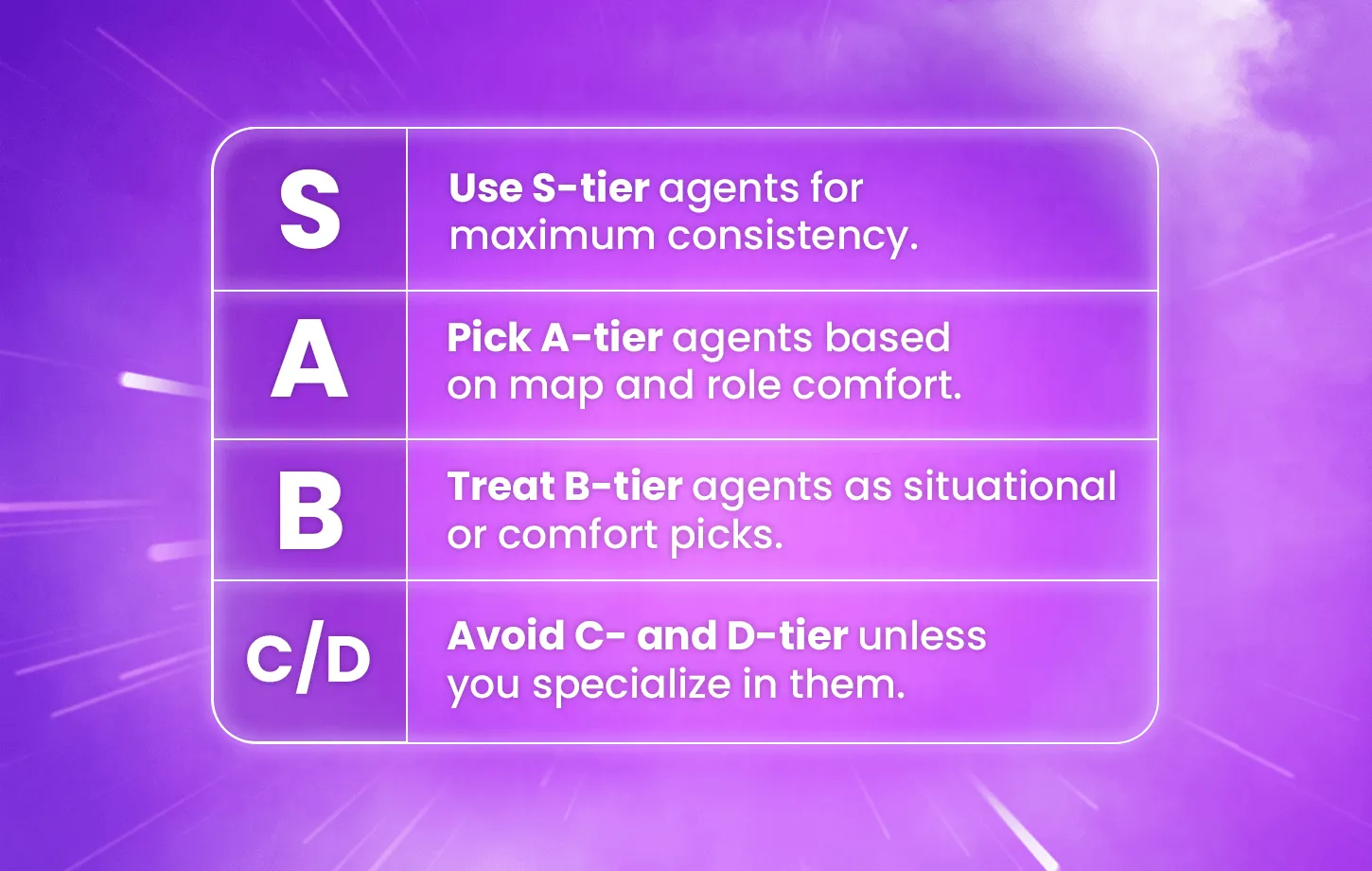
If GG Chest were you, you would focus on reducing unpredictable outcomes instead of working to create exciting moments. The quickest method to ascend is by choosing agents who perform well in rounds amidst chaotic scenarios, as shown in this Valorant agent tier list.
Map synergy: Best agent picks by map
Thinking, which is the best agent for each map Valorant? Well, tier lists don’t exist in a vacuum. Your agent gets stronger or weaker depending on the map’s geometry:
- Big open sightlines push agents like Viper (vision control) and Jett (Operator escape value).
- Tight choke points boost Raze, Breach, and Killjoy because utility forces guaranteed space.
- Vertical or “risk-drop” maps reward mobility picks like Jett and Omen.
The design of Valorant maps determines agent value because players must understand how map geometry enables them to control specific areas.
The Valorant map tier list: Best agent picks by map (current ranked rotation)
Map rotation in Valorant changes every couple of months, and agent strength always shifts with it. Right now, the current ranked map pool consists of: Corrode, Abyss, Breeze, Bind, Haven, and Split.
That matters more than most players realize. An agent that feels S-tier on one map can drop a full tier on another if the geometry doesn’t support their kit. If GG Chest were you, you wouldn’t ask “who’s the best agent overall?” — you’d ask “who’s the best agent for the maps I actually play this season?”
Below is a quick breakdown of how the current ranked rotation affects agent value.
We now know we are returning to specific rotations, but finding the best agent for each map Valorant is critical for the massive active map pool.
Best agent picks by map:
Corrode: Waylay, Jett | Fade, Breach | Omen, Clove | Deadlock, Sage.
Abyss: Jett, Waylay | Sova, KAY/O | Astra, Omen | Deadlock, Cypher.
Breeze: Neon, Jett, Yoru | KAY/O, Sova | Viper (must), Astra | Killjoy, Chamber.
Bind: Raze, Yoru | Fade, Skye | Brimstone, Viper | Killjoy, Veto.
Haven: Jett, Neon | Sova, Breach | Omen (must), Astra | Killjoy, Cypher.
Split: Raze, Yoru | Breach, Fade | Omen, Viper | Sage, Killjoy.
Format key: Duelist | Initiator | Controller | Sentinel.
Corrode
Corrode focuses on narrow turns, limited visibility, and continuous “contact” battles. You lack unlimited space to reset, as in open maps — you either seize control of a lane quickly, or you are overwhelmed by utility. This is why agents capable of breaching entry, controlling angles, and maintaining pressure post-trades are most suitable in this context.
Best agents for Corrode by role:
Duelist: Waylay, Jett
- Waylay fits Corrode because burst movement and quick strike patterns are brutal in close quarters. On this map, you don’t need long-range “perfect aim” duels — you need fast space and instant pressure, and Waylay’s kit is made for that.
- Jett remains top-tier due to her agility, allowing her to initiate contact without risking an easy kill. Corrode penalizes gradual glances, so Jett’s skill to dart away and restart battles makes her perpetually useful.
In general, Corrode favors agents capable of generating tempo, prompting responses, and enduring intense initial encounters rather than depending on gradual, calculated aim battles.
Initiator: Fade, Breach
- Fade is strong here because tight corridors make her utility harder to dodge. When info hits on Corrode, it often leads to immediate kills, not just “maybe they’re there.”
- Breach is a monster on Corrode because walls are everywhere, and teams are forced into narrow lanes. His stuns and flashes can guarantee space, but the key is simple: don’t use him like a solo hero — use him to open fights your team can actually win.
Together, Fade and Breach excel on Corrode by transforming information and crowd management into critical, battle-winning leverage.
Controller: Omen, Clove
- Omen is the best “universal” Controller for Corrode because he can adapt mid-round. His smokes block short lanes perfectly, and his blind creates free entry windows on tight chokes.
- Clove fits because Corrode rewards aggressive tempo. Even if you get traded early, you can still maintain pressure through smokes and keep your team’s execution stable. In messy ranked rounds, that “value after death” matters a lot.
Omen and Clove enable teams to have adaptable control, allowing them to set the pace and sustain pressure even when rounds don’t proceed smoothly.
Sentinel: Deadlock, Sage
- Deadlock fits Corrode because she punishes hard commits and locks lanes in tight areas. When teams are forced through narrow chokes, her utility becomes harder to ignore and easier to convert into stops.
- Sage operates more efficiently in this environment than on larger maps, since barriers and slow effects offer maximal advantages in confined spaces. She is able to postpone strikes, create safe planting zones, and turn chaotic rounds into a more structured form.
Consider Corrode as a “pressure map”: Choose a character that encourages mobility (Waylay/Jett), aids in initiating skirmishes (Fade/Breach), or brings order to disorder (Omen/Clove, Deadlock/Sage).
Abyss
Abyss is defined by verticality, open drops, and extreme punishment for positioning mistakes. One bad step can end the round instantly, which makes mobility, information, and controlled space far more important here than raw aggression.
On Abyss, the best agents are the ones that let you take risks without instantly losing the round.
Best agents for Abyss by role:
Duelist: Jett, Waylay
- Jett is almost mandatory on Abyss. Her mobility lets her contest dangerous angles, escape bad peeks, and reposition around vertical drops without risking her life. She turns risky fights into calculated pressure.
- Waylay suits her as explosive movements and swift entries enable her to take advantage of lone defenders. On Abyss, pace is prioritized over prolonged battles, and Waylay’s abilities shine in hit-and-reset tactics.
Overall, Abyss rewards teams that prioritize mobility and tempo over slow, extended duels.
Initiator: Sova, KAY/O
- Sova is highly effective on Abyss due to vertical layouts favoring reconnaissance. Effective use of darts and drones discloses locations without requiring teammates to risk check hazardous areas
- KAY/O brings suppression that shuts down mobility and escape tools, which is huge on a map where repositioning is everything. His flashes also help teams take space safely in high-risk areas.
In Abyss, precise information and utility-based space control frequently determine the outcome of rounds before raw aiming becomes significant.
Controller: Astra, Omen
Astra thrives on Abyss because of her global presence. She can control multiple levels at once, delay rotations, and pull defenders into bad positions without exposing herself.
Omen remains elite thanks to flexible smokes and reposition tools. His ability to smoke vertical sightlines and teleport across gaps gives teams safer ways to navigate the map.
This renders the flexibility of the Controller and the overall influence on the map much more significant in Abyss compared to fixed smoke configurations.
Sentinel: Deadlock, Cypher
- Deadlock fits. Abyss as it severely punishes hard commits and manages lanes where retreating isn’t viable. Her effectiveness grows more lethal when foes are pushed ahead.
- Cypher gains value here because information is survival. Watching flanks and vertical routes prevents surprise pushes and lets your team reposition before disaster hits.
Treat Abyss as a risk-management map: pick agents that let you gather info, suppress movement, and recover from mistakes instead of doubling down on raw aggression.
Breeze
Breeze exemplifies a long-range map with vision control. Unobstructed sightlines, lengthy rotations, and vulnerable plant areas signify one truth: if you can’t securely traverse the area, you forfeit rounds before the battle begins.
On Breeze, sheer aggression is penalized. The map incentivizes agents capable of obstructing sight, moving securely, and managing extended lines of sight. That’s the reason Controllers and Duelists who are easy to use excel in this area.
Best agents for Breeze by role:
Duelist: Neon, Jett, Yoru
- Jett stays elite on Breeze because Operator value is massive. She can take aggressive long angles, threaten first picks, and still escape safely. Without mobility, those peeks are suicide — Jett turns them into pressure.
- Neon operates unexpectedly efficiently in this situation, as her pace allows her to navigate dangerous open areas faster than defenders can react. On Breeze, the ability to obstruct sightlines via movement is almost as crucial as using smokes.
- Yoru fits because Breeze rewards fakes, lurks, and map-wide pressure. With so much space, his teleport and clone create constant uncertainty and pull defenders out of position.
On Breeze, dynamic movement and spatial control always surpass sluggish, stationary strategies
Initiator: KAY/O, Sova
- Sova is nearly essential on Breeze. Extended sightlines and open areas render his recon darts and drone exceptionally difficult to evade. Effective Sova utility transforms dangerous pushes into knowledgeable strategies.
- KAY/O introduces suppression that disables defensive utilities and escape mechanisms, essential on a map where defenders depend significantly on maintaining angles. His flashes assist teams in confronting Operators without exposing themselves unnecessarily.
On Breeze, managing information and restricting utility often emerge as crucial elements, rendering these agents especially vital for safe and effective operations.
Controller: Viper (must), Astra
- Viper is not open to negotiation on Breeze. Her wall divides the map, allowing secure site captures and rotations that conventional smokes cannot provide. Without Viper, many executions turn into chance events.
- Astra functions effectively with Viper due to her global influence. She can delay pushes, draw defenders away from angles, and assist various areas simultaneously — a trait that Breeze greatly values.
Control across the map and adaptable utility make these Controllers vital for safe execution and managing tempo on Breeze.
Sentinel: Killjoy, Chamber
- Killjoy fits Breeze because she can lock down sites and control post-plant scenarios in wide-open areas. Her utility forces attackers to respect space instead of flooding blindly.
- Chamber gains extra value here due to long sightlines and Operator dominance. If your aim is sharp, he can hold massive areas of the map alone and punish overextensions hard.
Consider Breeze as a conflict of perspectives. Choose agents that either block sightlines (Viper), utilize them safely (Jett/Chamber), or push defenders off angles without exposing themselves (Sova/KAY/O).
Bind
Bind is a tempo-and-deception map. With no mid and two teleporters, rounds are often decided not by aim, but by how well you fake pressure, force rotations, and explode onto sites before defenders can recover.
Bind heavily rewards agents that can clear space fast, control post-plants, and abuse rotations. If you hesitate here, you give defenders time to reset — and that’s how rounds slip away.
Best agents for Bind by role:
Duelist: Raze, Yoru
- Raze is almost perfect for Bind. Tight choke points, close-range fights, and clustered utility make her explosives insanely effective. She clears corners, breaks Sentinel setups, and turns site hits into chaos defenders can’t stabilize.
- Yoru excels on Bind due to teleporters enhancing his entire abilities. He can simulate website traffic, navigate through portals, and maintain ongoing unpredictability. In a map designed for misdirection, Yoru’s psychological tactics outweigh mere entry strength.
On Bind, bold utility and smart misdirection frequently surpass conventional dueling, rendering these agents particularly effective at generating confusion and area.
Initiator: Fade, Skye
- Fade is strong on Bind because narrow corridors make her utility harder to dodge. When her reveals land, they usually lead to immediate trades or kills, especially during fast hits.
- Skye fits Bind due to her ability to gather info and support explosive entries. Her flashes work well through tight chokes, and her recon tools help confirm whether a teleport fake actually pulled defenders.
Agents that merge dependable information collection with conflict-initiating tools consistently facilitate safer and more resolute site captures.
Controller: Brimstone, Viper
- Brimstone ranks as one of the top Controllers on Bind. His quick, enduring smokes allow for rapid executions, and his ultimate is highly effective in tight areas and after-plant situations. Link rewards to critical strikes — Brimstone truly shines in this aspect.
- Viper ensures lasting control and authority following planting. Her wall and mollies efficiently stop retakes, especially on sites where defenders need to traverse anticipated choke points.
On Bind, it is crucial to have agents that can deliver both instant execution help and ongoing site dominance to reliably secure victories in rounds.
Sentinel: Killjoy, Veto
- Killjoy fits Bind extremely well thanks to strong site lockdown and post-plant control. Once the spike is down, her utility forces defenders into uncomfortable clears.
- Veto shines here because Bind encourages predictable utility usage and rotations. He punishes teams that rely too heavily on standard setups, especially during repeated site hits and teleporter plays.
I’d treat Bind as a momentum map: pick agents that force fast decisions, abuse teleport pressure, and turn every plant into a nightmare retake for defenders.
Haven
Haven is a system of understanding and adaptation. Having three locations in play, simply intending to win won’t suffice — matches hinge on effectively interpreting enemy actions, asserting control from the start, and reacting faster than rivals.
Due to defenders being perpetually stretched, Haven favors agents that deliver dependable intel, adaptable smokes, and swift aggression. If your computer cannot adapt throughout the round, you’ll see it immediately.
Best agents for Haven by role:
Duelist: Jett, Neon
- Jett fits Haven perfectly because her mobility lets her pressure multiple sites without committing too hard. She can take early fights, threaten Operator angles, and still escape to apply pressure elsewhere. On a map where rotations are everything, that flexibility is priceless.
- Neon functions efficiently on Haven as quickness forces defenders to reveal details. Swift lane pressure or sudden site engagements punish teams that rotate either too early or too late. Neon turns Haven’s broad pathways into instruments for movement.
On Haven, agents capable of generating quick, adaptable pressure throughout the map continually interfere with defensive configurations and manage tempo.
Initiator: Sova, Breach
- Sova is among the most powerful choices on Haven because of the valuable intel it offers on a map with three sites. Effective use of recon darts and drones can quickly expose vulnerable areas and eliminate the need for guesswork during rotations.
- Breach shines on Haven because of how many walls and tight choke points exist around all three sites. His stuns and flashes can guarantee space during executes, especially when hitting C or retaking A.
The agents who can control sightlines and utility areas on Haven need to perform secure site operations and maintain organized team rotations.
Controller: Omen (must), Astra
- Omen is almost mandatory on Haven. His flexible smokes allow him to cover multiple sites, fake pressure, and adapt instantly when the round shifts. On a map where plans change mid-round constantly, Omen’s kit is unmatched.
- Astra works well as a secondary or alternative Controller thanks to her global utility. She can delay hits, punish rotations, and support sites without being physically present, which fits Haven’s layout perfectly.
On Haven, the ability to control space and manipulate rotations effectively is essential for securing victories in rounds.
Sentinel: Killjoy, Cypher
- Killjoy offers robust site anchoring and control after planting, essential when assailants attempt to quickly dominate a site. Her utility creates opportunities for rotations and penalizes careless advances.
- Cypher increases in worth on Haven due to the dominance of information. Teams can execute safe rotations by monitoring flanks, managing the middle game, keeping an eye on lurkers instead of taking risky choices.
If GG Chest were in your position, we would approach Haven as a trial for adaptation: select agents that assist in map awareness, adjust strategies during the round, and penalize poor rotations.
Split
Split is a utility layering map and a choke-point. Nearly every significant battle takes place in confined passageways, vertical angles, or restricted site entrances. As a result, Split significantly benefits teams that can accumulate utility, methodically clear space, and dominate vertical zones.
On Split, raw aim alone rarely wins rounds. The teams that dominate are the ones that deny space first, then take it cleanly.
Best agents for Split by role:
Duelist: Raze, Yoru
- Raze is one of the strongest duelists on Split because of how close-range and utility-heavy the map is. Her explosives clear corners, destroy Sentinel setups, and make holding tight angles miserable for defenders. On Split, Raze turns every choke point into a fight defenders don’t want to take.
- Yoru suits Split due to the plethora of rotation paths and deceptive chances available. His teleportation and duplication enable him to pressure the middle, sneak through connectors, and generate chaos in late-round scenarios.
In Split, agents that blend significant utility with broad mobility and deception regularly excel in battles and generate space for their teams
Initiator: Breach, Fade
- Breach is nearly custom-fit for Split. Barriers are abundant, constricted areas are narrow, and protectors are frequently positioned behind shields. His stuns and flashes can ensure space for both offense and retake, particularly near mid and site access points.
- Fade enhances this by providing reliable information and a corresponding structure. Limited spaces enhance her effectiveness, and when a reveal occurs, Split’s narrow routes turn that information into immediate pressure.
In Split, agents that blend space-manipulating utility with data-collecting skills thrive at controlling engagements and capturing locations
Controller: Omen, Viper
- Omen remains elite on Split because of his versatile smokes and repositioning abilities. He can obstruct essential sightlines, facilitate mid-control, and swiftly adjust when the round transitions from one site to another.
- Viper adds long-term control and post-plant strength. Her wall and mollies are especially effective on Split’s predictable choke points, denying retakes and forcing defenders into uncomfortable clears.
On Split, a flexible utility that obstructs sightlines, manages areas, and aids in post-plant situations is vital for reliably securing rounds.
Sentinel: Sage, Killjoy
- Sage is very effective on Split because of the walls and hinders reaching the optimal value in tight spaces. She can hinder essential routes, slow progress, and create safe planting zones that force defenders to use their resources.
- Killjoy excels on Split thanks to excellent site anchoring and control after planting. Her utility restricts spaces where defenders must navigate through tight openings, resulting in costly and slow retakes.
Treat Split as a discipline map: pick agents that layer utility, control mid, and punish impatience. When played correctly, Split rewards structure more than any other map in the rotation.
So, Valorant’s best agent, who is it?
Two agents stay elite almost everywhere because they solve the same ranked problem: chaos. It is Jett and Omen.
If you’re looking for the definitive best Valorant character tier list, keep in mind one thing: there isn’t a single “best agent” for every map and every player. That’s exactly why this guide uses a Valorant tier list plus map synergy — because ranked results depend on your map pool as much as your mechanics.
That being noted, certain selections remain outstanding in nearly every circumstance. Jett continues to be the most reliable choice for raw carry potential, whereas Omen remains the most intelligent “win more games with less stress” option due to adaptable smokes and steady round management.
For new players: Who is the best Valorant agent for beginners?
If you’re new and don’t want to overthink utility, pick agents that give value without complicated setups:
- Sentinel: Sage remains a top pick for beginners because her wall and heal create immediate impact with simple decision-making.
- The Entry: Phoenix is often cited as the best agent in Valorant for beginners because he teaches flashing, entry timing, and self-sufficiency without needing lineups.
Is the Valorant tier list settled?
Not even close. Meta shifts happen as players adapt, map rotations change, and Riot tunes balance. The safest approach is to stick to agents that stay useful in messy ranked games: space creation, flexible smokes, and reliable information. That’s why this list focuses on consistency, not hype.
If you’re trying to rank up with limited time, don’t pick based on “who looks OP on TikTok.” Pick based on who wins ugly rounds — the ones where your team doesn’t talk, someone lurks for no reason, and you still need to scrape a win.
Unlocking the best character in Valorant
With new agents expected to go live in the coming months, rumors around unlocking have intensified.
- Free Path: Expected to sit at the current industry standard of grinding Kingdom Credits.
- Xbox Game Pass: Multiple sources indicate that these bundles will cost a monthly subscription while providing immediate access to the best agent in Valorant and all other characters.
The official announcement will reveal the complete balancing details for this Act, but Riot appears to be setting distinct roles for all agent classes.
Match point
The meta is defined. The competitive season of 2026 will bring the best Valorant agents to the forefront, according to the official tier list of January 2026. The method has transformed from a random pick guessing game for team comps into an exact utility measurement system that tracks down the winning conditions.
And yet, while you wait to unlock every character, why don’t you look at some Valorant accounts?