Accounts
 Currency
 Items
Items


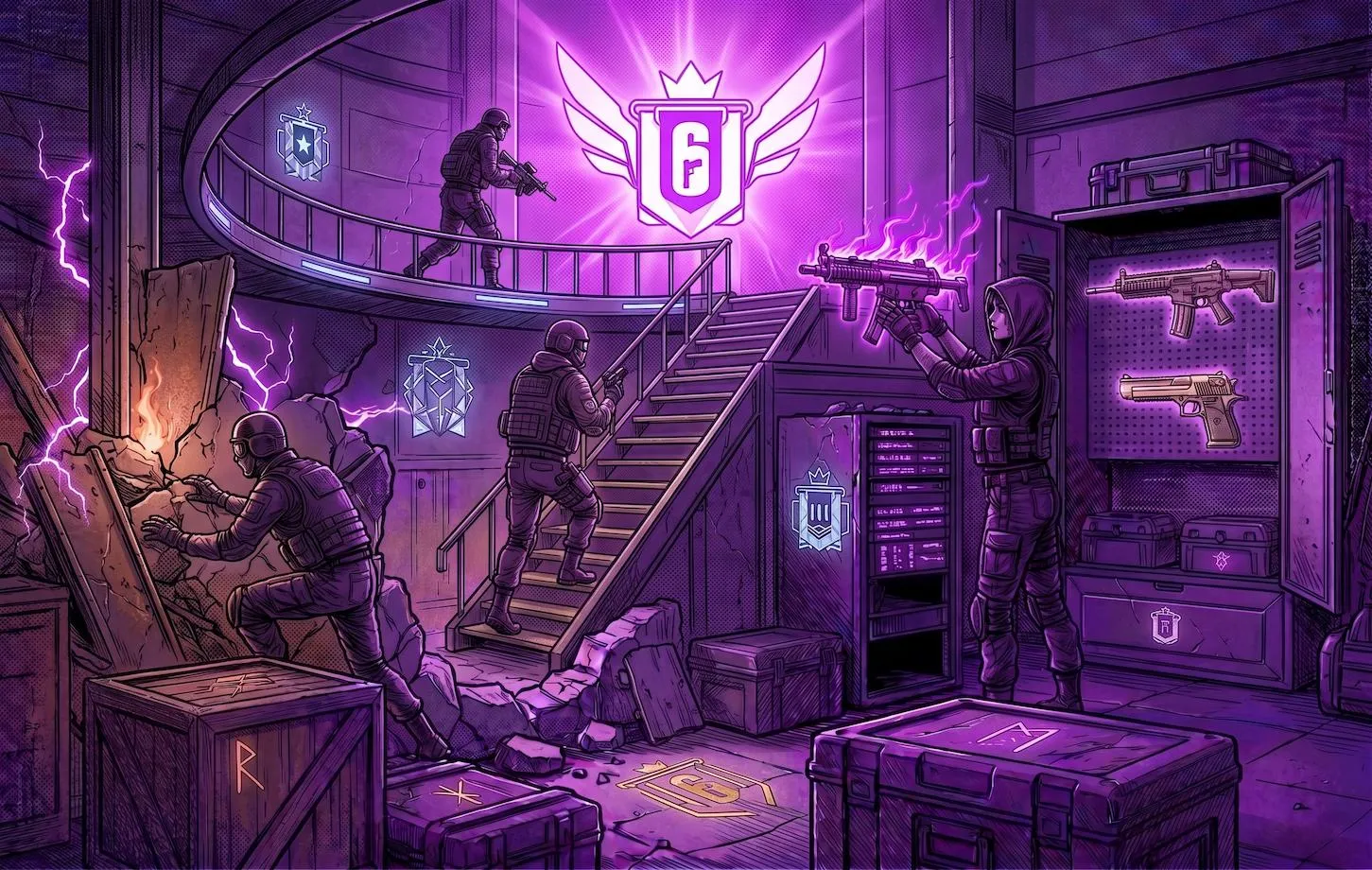
Rainbow Six Siege Ranks: All 36 Ranks Explained (2026)
Rainbow Six Siege all ranks span 8 tiers and 36 divisions, from Copper V (the lowest) to Champion (the highest). If you’re wondering what the ranks in Rainbow Six Siege are, they include Copper, Bronze, Silver, Gold, Platinum, Emerald, Diamond, and Champion. The 8 tiers are Copper, Bronze, Silver, Gold, Platinum, Emerald, Diamond, and Champion.
All ranks besides Champion have 5 sub-ranks (V I), and have visible rank numbers (RP) as well as a Skill rating that actually matches the player’s skill and is used in matchmaking. This guide covers every tier with exact RP thresholds, current distribution data, and proven climbing strategies for 2026. Every division is listed, explained, and contextualized below.
How does the Rainbow Six Siege ranking system work?
The Rainbow Six Siege ranking system uses a dual-metric approach: visible Rank Points (RP) determine the displayed rank, while a hidden Skill rating controls matchmaking. What Siege X does go a long way in showing is the continued evolution of the ranked structure that was first really introduced back in Year 7 with Ranked 2.0.
On average, our RP gains and losses per match are around 80 points. Therefore, matches can either earn RP or lose RP. The amount at which we gain or lose RP is determined by match factors such as stack size (5-stack penalty, for example) and individual performance, as well as the difficulty of the match against other teams. Our perceived rank that others see will be roughly in the same tier as our Skill value, possibly swinging above and below the average RP for that value. Additionally, every ranked level that you are in will grant you a certain amount of gain per match, and you will need to accumulate enough RP to “jump up” to the next ranked level. This gain generally averages around 25 RP per match.
The hidden Skill rating, formerly called MMR, is an invisible metric that represents a player’s actual competitive ability. Hidden MMR R6 does not reset between seasons, ensuring stable opponent matching even after a seasonal rank reset. It’s worth noting that true skill is calculated differently from your in-game reported MMR. So, how to see hidden MMR R6? Unfortunately, Ubisoft does not report a R6 hidden MMR in their game, but you can check your ranked stats and other information on third-party community trackers like R6 Tracker or Tabstats. This is as close as you’re going to get to learning more about the ranking system in Siege.
The system self-corrects over time. Players who appear to have a lower rank than their actual Skill will receive increased RP, while those who appear to have a higher rank than their actual Skill will receive decreased RP. This feature encourages players to compete for a rank that better reflects their skills, rather than playing as many games as possible to climb the ladder.
Clearance Level 50 is the minimum requirement to queue for ranked matches. This threshold ensures that new players develop baseline map knowledge, operator familiarity, and game sense before entering competitive play. How does Siege ranked work in practice: Reach Level 50, enter the ranked playlist, earn RP through wins, and climb through the 36-division ladder.
What are all 36 Rainbow Six Siege ranks in order?
The 36 ranks in order span 8 tiers from Copper V (the lowest) to Champion (the highest). Each tier except Champion contains 5 subdivisions (V, IV, III, II, I), with 100 RP separating each subdivision. Here are all 8 Rainbow Six Siege ranks in order, from lowest to highest:
- Copper (0–499 RP) — Entry tier. Every player starts here each season after the full reset.
- Bronze (500–999 RP) — Most populated tier. Players grasp core mechanics but lack consistent execution.
- Silver (1,000–1,499 RP) — Above-average awareness. 15–20% of ranked players sit here.
- Gold (1,500–1,999 RP) — Solid fundamentals. The widest skill gap within a single tier.
- Platinum (2,000–2,499 RP) — Top 10%. Strong mechanics combined with tactical game sense.
- Emerald (2,500–2,999 RP) — Top 5%. Added in Ranked 2.0 to bridge Platinum and Diamond.
- Diamond (3,000–3,499 RP) — Top 2%. Exceptional skill with advanced tactical execution.
- Champion (5,000+ RP) — Top 0.4%. Approximately 2,500 players globally. No subdivisions.
The full RP breakdown for every subdivision is listed in the table below:
| Rank Tier | Subdivisions | RP Range |
| Copper | V, IV, III, II, I | 0–499 |
| Bronze | V, IV, III, II, I | 500–999 |
| Silver | V, IV, III, II, I | 1,000–1,499 |
| Gold | V, IV, III, II, I | 1,500–1,999 |
| Platinum | V, IV, III, II, I | 2,000–2,499 |
| Emerald | V, IV, III, II, I | 2,500–2,999 |
| Diamond | V, IV, III, II, I | 3,000–3,499 |
| Champion | None | 5,000+ |
The R6 ranks follow a linear RP progression from Copper V at 0 RP to Champion at 5,000+ RP. The ladder contains 35 subdivision-based ranks plus 1 undivided Champion tier, totaling 36 distinct competitive levels. Every rank is earned exclusively through RP accumulation in the ranked playlist.
What rank is Copper in Rainbow Six Siege?
Copper | 0–499 RP | 5 divisions | Starting tier for all players each season
Copper is the entry rank in Rainbow Six Siege, spanning Copper V (0 RP) through Copper I (400–499 RP). No matter what your pre-season ranking may be, you’ll always begin the year in Copper V rank along with the rest of the competitive Player Base. Every player in Copper is either new to ranked play, coming back from a previous season with a clean slate, or trying to find their accurate Skill rating. The highest populated place at the start of a new season is hands down Copper V.
What rank is Bronze in Rainbow Six Siege?
Bronze | 500–999 RP | 5 divisions | Most populated tier (~32,000 players per division)
Bronze spans Bronze V (500 RP) through Bronze I (900–999 RP). Bronze V and Bronze IV are the most populated divisions, with approximately 6.1% of players in each subdivision—roughly 32,000 players per division based on R6 Tracker data from January 2026. Most players settle in Bronze after their initial climb from Copper. Bronze players have a grasp of the fundamental mechanics in Battlefield 1, such as leaning, reinforcing structures, and using operator gadgets; however, their ability to execute these actions consistently does not yet exist.
What rank is silver in Rainbow Six Siege?
Silver | 1,000–1,499 RP | 5 divisions | Top 40% — above-average game awareness
Silver spans Silver V (1,000 RP) through Silver I (1,400–1,499 RP). Silver players demonstrate above-average game awareness, including basic map knowledge, operator role understanding, and callout familiarity. Despite a lot of time in the tier, execution just isn’t there in key situations such as aim duels, timing out utility, and quickly retaking sites. Silver is the second most populated ranked tier at about 15-20% of the ranked playerbase, with Bronze holding the majority at about 30-40%.
What rank is Gold in Rainbow Six Siege?
Gold | 1,500–1,999 RP | 5 divisions | Top 25% — solid fundamentals and consistent aim
Gold spans Gold V (1,500 RP) through Gold I (1,900–1,999 RP). Gold players demonstrate solid fundamentals: Consistent aim, map knowledge across all ranked maps, and reliable communication through callouts. For most committed players with a generally average skillset, this is where you’ll end up after each seasonal boost. The skill difference between a Gold V player and a Gold I player is strangely large for a single rank, with the main distinction being between players that can reliably play at a mechanical level and those who can also execute at a high level while using matching strategies, picking decent picks and bans, using relevant utilities, and making generally smart decisions throughout the game.
What rank is Platinum in Rainbow Six Siege?
Platinum | 2,000–2,499 RP | 5 divisions | Top 10% — strong mechanics with tactical game sense
Platinum spans Platinum V (2,000 RP) through Platinum I (2,400–2,499 RP). We estimate that the player quality for Platinum is around the top 10% of the competitive playerbase. As a player at this level, you will have solid mechanical skills as well as good game sense to back it up. This means having knowledge of when to pre-aim at locations, effectively managing the drone caused economy fluctuations, and good timing with utility. The difference between Gold I and Platinum V is a quality leap unlike any other, and it requires the player to shift from being reactive to being highly proactive in-game.
What rank is Emerald in Rainbow Six Siege?
Emerald | 2,500–2,999 RP | 5 divisions | Top 5% — added in Ranked 2.0
Emerald spans Emerald V (2,500 RP) through Emerald I (2,900–2,999 RP). The Rainbow Six Siege Emerald rank was introduced with the Ranked 2.0 overhaul to create a smoother progression curve between Platinum and Diamond. This tier did not exist in the original ranking system. Emerald players rank in approximately the top 5% of the competitive playerbase. Many returning players who last competed before Ranked 2.0 may not recognize this tier.
What rank is Diamond in Rainbow Six Siege?
Diamond | 3,000–3,499 RP | 5 divisions | Top 2% — exceptional mechanical and tactical skill
Diamond spans Diamond V (3,000 RP) through Diamond I (3,400–3,499 RP). These are the top 2% of competition at Diamond levels of play. It takes a special brand of player to ascend to this level, generally a very strong combination of mechanical play and tactical execution, often manifested in the form of early, precision pre-aim, perfectly timed utility, or coordinated team site executes. Diamond is the final multi-subdivision in rank before players reach the elusive Champion status. The highest rank on Siege below Champion is Diamond I at 3,400–3,499 RP.
What rank is Champion in Rainbow Six Siege?
Champion | 5,000+ RP | No subdivisions | Top 0.4% — ~2,500 players globally
Champion is the apex rank in Rainbow Six Siege, requiring 5,000+ RP with no subdivisions. Champion represents the top 0.4% of ranked players—approximately 2,500 players globally as of January 2026, based on R6 Tracker data across 522,000+ active ranked accounts. The players at this level would be considered professional competitors, semi-professional players, or content creators. Reaching the Champion tier requires consistent high win rates and a considerable amount of playtime each season. Typically, this translates to more than 200+ matches per season.

How does the Siege ranked system differ from Casual and Unranked?
The Siege ranked system differs from Casual and Unranked in 3 key areas: Entry requirements, match format, and progression tracking.
Entry requirements separate the modes. Ranked requires Clearance Level 50, which answers what level to play ranked siege. Casual has no level requirement. Unranked requires owning the game but imposes no level gate. Players on Siege X need to reach Clearance Level 50 through standard multiplayer progression. These ranked requirements ensure competitive readiness before entering the ranked playlist.
Match format varies across all 3 modes. Ranked uses the MR12 format (first team to 7 rounds wins), creating longer, more tactical matches. Games played in Casual mode follow the abbreviated MR4 format (first to 4 rounds). Unranked games follow the same Ranked format (MR12) but do not affect a player’s RP and are commonly used for warm-up before competitive training.
Progression tracking is exclusive to Ranked. The system tracks RP and hidden Skill; Casual and Unranked maintain separate hidden MMR pools that do not influence ranked progression. Ranked also enforces abandon penalties (RP loss plus temporary matchmaking bans) and applies stricter anti-cheat measures, including the Level 50 threshold and conduct rules.
What is the current Rainbow Six Siege rank distribution?
The R6 rank distribution follows a steep pyramid structure, with over 60% of ranked players concentrated in Bronze and Silver tiers. The following percentages are based on R6 Tracker data from January 2026, covering 522,000+ active ranked players.
Bronze V has the highest percentage of the ranked population at 6.1% (around 32,000 players). Bronze V is barely bested by Bronze IV at 6.0%. Interestingly, most ranked players are stuck in some level of Bronze or Silver. While Gold accounts for around 15% of the ranked players, Platinum takes up the top 10%. This picture shows the jewelry scale from left to right with the gemstone name above each section. The Emerald shown above is a top 5% Emerald. The Diamond shown above is a top 2% Diamond. Champion accounts for the top 0.4%—approximately 2,500 players globally. Reaching Gold already places a player above roughly 60% of the competitive population.
The all-R6 ranks in order shift each season slightly due to the full reset mechanic. Early-season data skews heavily toward Copper and Bronze as all players climb from Copper V. Mid-to-late season data reflects the stabilized distribution. Distribution differs by platform, with PC generally exhibiting a somewhat flatter curve compared to console, attributed to varying player demographics and input methods. The 2026 numbers indicate the increased player base and seasonal variations of Year 10 Season 4.
Knowing the Rainbow Six Siege ranked distribution can give players an idea of where they rank in the competitive pool of Battleborn players. For reference, those who reach Gold rank are significantly above the average player, indicating that they fall within the top 10% of players, placing them solidly in the top 10% of the ranked population. Comparing your Platinum rank from season to season can give you an idea of where you are improving and what areas you need to continue to work on. Monitoring distribution data across various seasons shows authentic skill advancement that goes beyond mere rank classifications.
How does the seasonal rank reset work in Rainbow Six Siege?
Every ranked season (approximately 3 months), all players reset to Copper V regardless of their previous rank. Ubisoft implemented a complete reset for players to regain their rank every season, avoiding stagnant ladders and promoting ongoing competitive involvement
Hidden Skill does not reset. Only apparent RP resets to zero. This distinction is vital: The concealed MMR remains consistent through seasons, guaranteeing that a Diamond-level player does not encounter true Copper-level opponents while ascending back. The concealed Skill value preserves matchmaking fairness despite the displayed rank being Copper V.
Accelerated RP gains compensate for the full reset. Players whose hidden Skill is far above their visible rank earn significantly more RP per win (and lose less per loss) in early-season matches. For a player with Diamond Skill Rank, their Skill will typically fluctuate between Diamond and possibly Platinum after about 40-60 games. This increase in Skill Rank is expedited because of MMR convergence, meaning Skill converges to visible rank much faster the farther away Skill is from rank. Also, as RP increases significantly the moment you are farther away from your rank, the rate of gaining RP will increase.
Early-season matches can be volatile. Diamond and Champion players grinding through lower ranks create uneven matchups during the first 1–2 weeks of each season. This volatility decreases as high-Skill players climb back to their appropriate ranks.
Rewards will be granted based on your ranking at the end of a season, and that season’s highest rank will be rewarded with a season-specific one-of-a-kind charm, which will show your highest rank of that season. This season’s charm will be permanent and visible on all of your weapons.
Ubisoft has acknowledged that Ranked 2.0 has not hit the mark yet and is planning a Ranked Overhaul for Y11S2 (expected mid-2026). The overhaul is expected to address the full reset controversy, RP acceleration mechanics, and rank inflation concerns. Siege ranked 3.0—or its official equivalent—may introduce changes to how seasonal progression and matchmaking interact. Players tracking ranked 3.0 Siege updates should monitor Ubisoft’s official developer blogs and patch notes for confirmed details.
What are the best strategies to climb ranks in Rainbow Six Siege?
The 5 most effective strategies to climb Rainbow Six Siege ranks are: Mastering 2–3 operators per role, learning callouts for all ranked maps, playing with a consistent squad, reviewing gameplay VODs, and focusing on utility usage over raw aim.
- Operator mastery produces the highest return on invested practice time. Pick 2–3 attackers (such as Ash, Sledge, or Thermite) and 2–3 defenders (such as Jäger, Mute, or Smoke). Learn every engagement angle, ability interaction, and counter for those operators. Depth on a small roster outperforms shallow knowledge of many operators at every level of the ranked ladder.
- Map knowledge directly translates to RP gains. Knowing camera positions, default rotation holes, vertical play opportunities, and common plant sites eliminates guesswork during rounds. Ranked maps rotate each season—study the current pool and learn 2–3 site setups for each map on defense.
- Squad play reduces variance. Solo queue introduces unpredictable teammate behavior and inconsistent communication. A 3–5-stack with voice comms enables coordinated attacks, reliable callouts, and preplanned defensive setups. What ranks can play together R6: The matchmaking system restricts party rank ranges at higher tiers, so squad members should maintain similar ranks for optimal queue times and competitive balance.
- VOD review reveals mistakes invisible in real-time. Watching recorded games and looking back at mistakes, like when you died, messed up a clutch, or lost a round, can help you see what you did wrong with your position, timing, and use of abilities. Even pro players review their games after each session – it’s a good habit to get into, no matter if you’re a beginner or a top player.
- Utility over aim is the factor that separates Siege from other tactical shooters. All these special items (drones, breach charges, Valkyrie cameras, Maestro Evil Eyes) give players information and map control that regular mechanical aiming cannot. A player who drones every room before moving in often wins more rounds than the player who is relying solely on their reaction time.
Players who want to start competing at a higher rank immediately can explore verified Rainbow Six Siege accounts on GG Chest, with instant delivery and escrow protection on every listing.
Which operators give the best advantage for ranking up?
The operators with the highest-ranked win rates in 2026 are concentrated in 3 roles: Hard breachers (Thermite, Ace), intel gatherers (Valkyrie, Zero), and anchor defenders (Mira, Smoke).
Hard breachers are important for opening up hardened walls to allow for different entry points for a site-wide takeover. In Siege ranked, teams would approach without a hard breacher and get ambushed by defenders set up in some of the most natural positions on the map. Thermite is decent at removing walls one at a time, though it doesn’t really get a great return on investment for the effort. Unlike other hard breach options, however, Ace can quickly remove multiple walls and also attack defenders using the hardest to access positions on the map. He does have some trouble with the hardened defenders equipped with SELMA charges, but he seems to handle them okay.
Intel gatherers provide the most valuable resource in competitive Siege: Information. Valkyrie deploys covert Black Eye cameras that persist across rounds, providing defender-side intel on attacker positions and push timing. Zero fires Argus cameras at destructible surfaces or through reinforced surfaces for attacker-side behind-the-lines surveillance. In the current Siege X-ranked system, teams that include a dedicated intel player tend to win more rounds because they base their pulls on observed enemy positions.
Anchor defenders hold objective sites against pushes, creating time pressure that forces attackers into mistakes. This Mira Black Mirror setup lets you get one-way vision of reinforced walls and looks, and allows for lances or pushes after seeing what you’re up against safely. Smoke’s gas doesn’t allow for area control in the last 15 seconds of a match, which is probably the most important time for area control on any map that exists in the ranked pool.
Operator pick rates shift with balance patches, and seasonal rotations introduce operator adjustments that can significantly affect win rates. These recommendations reflect the Y10S4 / Y11S1 meta. For players aiming to push toward the highest rank on Siege, choosing operators with strong utility and consistent value is really important. For a complete breakdown of every operator ranked by performance, see the Rainbow Six Siege operator tier list.
Frequently asked question
How many placement matches are required to get a rank?
Ranked 2.0 eliminated traditional placement matches. All players start at Copper V each season and climb through RP gains. This new system replaced the 10-placement-match method that existed before Year 7, in which players started the season at a rank based on their skill level. There is a new system bug known as “Hidden Skill” that is causing experienced players to gain RP at a faster rate than new players. As a result, experienced players are promoted to their true rank before the new players who started at the same rank.
Can players lose rank points for abandoning a match?
Yes, abandoning a ranked match results in an RP penalty and a temporary matchmaking ban. First offense incurs a 30-minute ban. Repeated offenses escalate to longer bans: 2 hours, 24 hours, and up to 7 days for persistent abandoners. The abandoned match counts as a loss for RP calculation. Teammates of the abandoner also lose RP but receive a reduced penalty.
Does Rainbow Six Siege have cross-platform ranked?
Rainbow Six Siege can feature cross-platform ranked play on PlayStation and Xbox in the form of a single, shared “console” pool, despite PC players being grouped separately. This is an important part of the Rainbow Six Siege ranking system, because Ranked Skill and RP are still tied to the specific platform pool where matches take place. Cross-progression via Ubisoft Connect does, however, mean players can carry rank progression and cosmetics across platforms via their Ubisoft Connect account. Ranked Skill and RP stay connected to the platform pool where games occur.
What happens to rank points during server outages or disconnects?
Ubisoft’s system detects server-side disconnections and does not apply RP penalties when the disconnect originates from server infrastructure. Any disconnections on the client side caused by the player’s internet issues will be treated as an abandonment and result in loss of RP and possible matchmaking penalties for that player. Players who feel they received an RP penalty for a server-side issue can report the incident in the Ubisoft Help portal, and a support case will be created to investigate.